
The Amboseli Conservation Program (ACP) is one of Africa’s longest-running and most influential wildlife research and conservation initiatives that we seek to highlight here at Amboseli.ke as part of Amboseli Conservation Initiatives. Founded in 1967, ACP has shaped how scientists, policymakers, communities, and conservation organizations understand—and protect—the Amboseli ecosystem and its iconic wildlife, especially elephants.
This guide explains what ACP is, why it matters, how it works, what it has achieved, and how it fits into the wider Amboseli conservation landscape—including how it differs from newer ecosystem-wide planning efforts. It is designed for readers of Amboseli.ke who want a clear, credible, and complete reference to conservation in Amboseli.
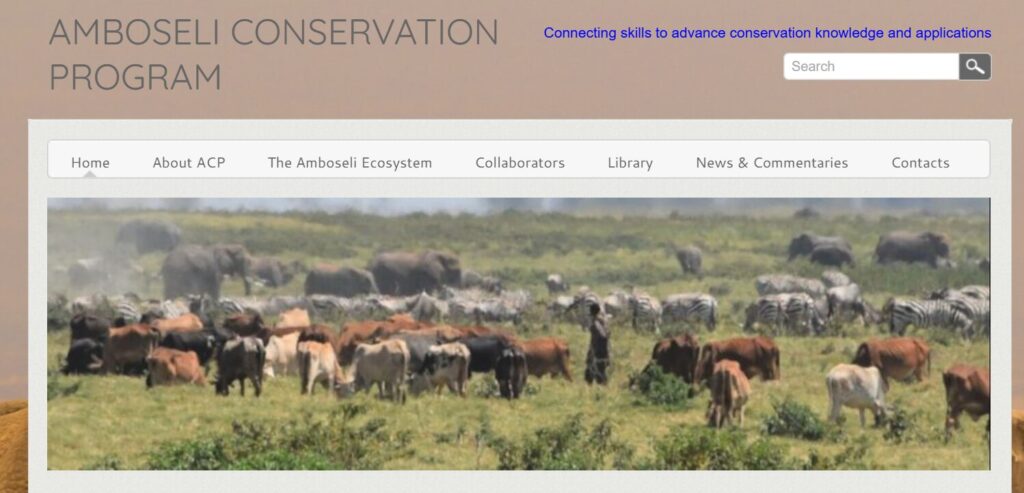
1) What Is the Amboseli Conservation Program?
Amboseli Conservation Program (ACP) is a long-term, science-driven conservation initiative dedicated to:
- Conducting ecological and wildlife research in the Amboseli ecosystem
- Developing tools to identify threats to biodiversity
- Informing conservation policy and practice that benefit both wildlife and people
- Building local and national capacity for conservation
- Promoting sound environmental governance
- Fostering national and international collaboration in conservation
Since the late 1960s, ACP has produced one of the world’s most continuous datasets on African savanna ecosystems, making Amboseli a global reference site for understanding wildlife populations, climate variability, land use change, and human–wildlife coexistence.
2) Why Amboseli Matters (Ecosystem Context)
The Amboseli ecosystem spans far beyond the boundaries of Amboseli National Park and includes:
- Seasonal wetlands and swamps fed by underground water from Mt. Kilimanjaro
- Savanna, woodland, and bushland habitats used by migratory wildlife
- Community lands and group ranches that are critical wildlife dispersal areas and corridors
- A globally significant population of African elephants, along with lions, cheetahs, hyenas, giraffes, zebras, wildebeest, and hundreds of bird species
Because wildlife in Amboseli depends heavily on land outside the park, conservation here is fundamentally about landscape-scale management, not just protected areas. ACP’s work has been central to demonstrating this reality with rigorous data.
3) A Brief History of ACP
- 1967: The program is founded, initially focusing on large mammal ecology and ecosystem dynamics.
- 1970s–1990s: Long-term monitoring of elephants and other key species establishes Amboseli as a premier research site for population dynamics, behavior, and human–wildlife interactions.
- 2000s–present: ACP expands its focus to include climate impacts, land use change, community livelihoods, governance, and applied conservation policy, while maintaining its core strength in long-term ecological data.
Few conservation initiatives in Africa can match ACP’s continuity, which is exactly what makes its datasets so valuable for understanding trends rather than snapshots.
4) Core Research Themes
4.1 Elephant Research and Population Ecology
ACP is globally renowned for its elephant research, including:
- Individual identification and life-history tracking
- Demography: births, deaths, age structure, and family lineages
- Social structure and behavior
- Impacts of drought, climate variability, and habitat change
- Human–elephant conflict and coexistence strategies
This work has influenced international elephant conservation policy and best practice far beyond Kenya.
4.2 Ecosystem Dynamics
ACP studies how rainfall, vegetation, soils, water availability, and wildlife interact over time, helping answer questions such as:
- How do drought cycles reshape wildlife distribution?
- What happens when traditional grazing patterns change?
- How do swamps and wetlands buffer ecosystems during dry periods?
4.3 Land Use Change and Fragmentation
A major focus is how agriculture, fencing, settlement, and infrastructure affect:
- Wildlife migration routes and dispersal areas
- Predator–prey dynamics
- Conflict between people and wildlife
- Long-term ecosystem resilience
4.4 Climate Variability and Adaptation
With decades of data, ACP is uniquely placed to show how climate variability and climate change influence:
- Species survival and reproduction
- Vegetation patterns and water availability
- Pastoral livelihoods and land-use decisions
5) Conservation in Practice: From Science to Policy
One of ACP’s defining strengths is bridging research and real-world decision-making. This includes:
- Providing evidence for land-use planning and wildlife corridor protection
- Informing park and ecosystem management strategies
- Supporting community-based conservation models
- Contributing to national and county-level conservation policy
- Advising on human–wildlife conflict mitigation strategies grounded in data, not guesswork
In short, ACP is not only about publishing research—it is about making conservation work on the ground.
6) Communities and Coexistence
Amboseli’s wildlife survives largely because it shares space with pastoralist communities, especially the Maasai. ACP’s work recognizes that:
- Conservation cannot succeed without local community engagement and benefits
- Traditional knowledge and land-use practices are part of the conservation solution
- Secure livelihoods and grazing systems reduce pressure to convert land to incompatible uses
- Coexistence requires practical tools for conflict prevention and response, especially with elephants and predators
Over time, ACP’s research has helped shift the conservation narrative from “parks vs. people” to “people and wildlife in shared landscapes.”
7) Governance and Collaboration
ACP operates through partnerships with:
- Kenyan conservation authorities and research institutions
- Local communities and landowners
- Universities and international research organizations
- Conservation NGOs and policy bodies
This collaborative model reflects a key lesson from Amboseli: no single institution can manage a complex ecosystem alone.
8) ACP and the Amboseli Ecosystem Restoration & Planning Efforts (ACP vs. AERP)
Readers often encounter both ACP and broader ecosystem planning or restoration initiatives in Amboseli. The distinction is important:
- Amboseli Conservation Program (ACP)
- Primarily a research and evidence-generation institution
- Focuses on long-term data, monitoring, and analysis
- Provides the scientific backbone for conservation decisions
- Influences policy and practice through evidence
- Ecosystem-wide planning or restoration programs (e.g., AERP-type initiatives)
- Focus more on implementation, planning frameworks, and coordinated action across the ecosystem
- Translate science into multi-stakeholder strategies (land use, corridors, restoration, governance)
- Are typically time-bound programs or plans, rather than continuous research platforms
In practical terms: ACP generates and curates the knowledge base; ecosystem plans and restoration initiatives use that knowledge to coordinate action at scale. They are complementary, not competing.
9) Key Conservation Challenges in the Amboseli Ecosystem
ACP’s research highlights several persistent, interconnected challenges:
- Land fragmentation and loss of wildlife corridors
- Human–wildlife conflict, especially with elephants and predators
- Climate stress: more frequent and severe droughts
- Pressure from agriculture and infrastructure development
- Governance complexity across park, county, and community lands
Understanding these dynamics is essential for anyone serious about conserving Amboseli in the long term.
10) Why Long-Term Research Matters
Short projects can miss slow, structural changes. ACP’s multi-decade datasets allow conservationists to:
- Distinguish temporary fluctuations from real trends
- Evaluate which interventions actually work over time
- Anticipate future risks based on past patterns
- Build credible, defensible policy recommendations
This is why ACP is often cited as a global model for long-term ecosystem research.
11) How You Can Support Amboseli Conservation
Whether you are a traveler, researcher, donor, or conservation partner, you can contribute by:
- Supporting credible, science-based conservation organizations working in Amboseli
- Choosing responsible tourism operators who respect wildlife corridors and community lands
- Learning about and advocating for landscape-level conservation, not just park protection
- Sharing accurate information about Amboseli’s conservation challenges and successes
- Engaging with local initiatives that promote coexistence between people and wildlife
12) Frequently Asked Questions (FAQs)
Is the Amboseli Conservation Program the same as Amboseli National Park management?
No. ACP is a research and conservation program, not the park authority. It provides data and insights that inform management and policy.
What is ACP best known for?
Its long-term elephant research and ecosystem monitoring, which are among the most detailed in the world.
Does ACP work with local communities?
Yes. Community land use, livelihoods, and coexistence are central to ACP’s research and applied conservation focus.
How does ACP influence policy?
By providing credible, long-term evidence that shapes land-use planning, conservation strategies, and governance decisions.
13) ACP’s Place in the Future of Amboseli
As pressures from climate change, population growth, and land conversion increase, the need for evidence-based conservation becomes even more urgent. ACP’s role—as a guardian of long-term ecological knowledge—is more relevant today than ever.
The future of Amboseli will depend on integrating science, community stewardship, and smart policy. For over half a century, the Amboseli Conservation Program has shown what that integration can look like in practice.
Amboseli Conservation Program (ACP): Key Milestones and Historical Impact
| Period / Year | Milestone | Why It Mattered for Amboseli and African Conservation |
|---|---|---|
| 1967 | David Western begins ecological research in Amboseli | Launched one of Africa’s longest continuous ecosystem studies; reframed conservation to include pastoralism and wildlife coexistence |
| 1969 | Maasai Amboseli Land Use / Park Plan developed | Introduced the “core park within a wider ecosystem” model and positioned communities as beneficiaries of tourism |
| 1973 | ACP formally coalesces; Ecosystem Tourism Development Plan produced | Integrated science, land-use planning, and tourism economics at landscape scale |
| 1973 | Elephant research program launched under Cynthia Moss | Became the world-leading long-term elephant study (later the Amboseli Elephant Research Project) |
| 1974 | Amboseli declared a National Park; ACP helps arbitrate revenue-sharing compromise | Preserved community stake in tourism and set precedent for negotiated conservation governance |
| Late 1970s | Western establishes Kenya Wildlife Planning Unit | Embedded ecosystem-scale and community-based conservation into national policy |
| 1977–1978 | Kenya Wildlife Policy and Tourism & Wildlife Program supported | Helped restructure Kenya’s wildlife sector toward ecosystem-wide management |
| 1982–1990 | Leadership in African Elephant & Rhino Specialist Group | Elevated Amboseli science to continental and global conservation policy arenas |
| 1984 | Parks for Sustainable Development (World Parks Congress) | Advanced the global shift toward people-centered, sustainable conservation models |
| 1988–1990 | Ivory Trade Review Group; Co-founds International Ecotourism Society | Linked science, policy, and sustainable tourism at global scale |
| 1991–1993 | Formation of Amboseli community scouts; support for Biosphere Reserve; major community conservation workshops | Operationalized community-based conservation and local stewardship in Amboseli |
| 1994 | African Conservation Centre (ACC) established with ACP roots | Institutionalized ACP’s principles nationally and regionally |
| 1995 | David Western appointed Director of Kenya Wildlife Service | Marked the translation of ACP ideas into national wildlife governance |
| 1996–1997 | Minimum Viable Conservation Area and Parks Beyond Parks concepts adopted | Cemented landscape-scale conservation as national policy doctrine |
| 2004 | Promotes South Rift Association of Landowners; contributes to Amboseli Ecosystem Management Plan | Strengthened corridor conservation linking Amboseli and Maasai Mara |
| 2007 | South Rift Resource Centre established | Expanded applied conservation, community engagement, and land-use planning capacity |
| 2008 | Launch of transboundary, land fragmentation, climate, and bioinformatics initiatives; helps form Amboseli Ecosystem Trust | Modernized conservation with climate science, data systems, and cross-border coordination |
| 2009 | Emergency drought response and national advocacy | Demonstrated ACP’s role in crisis response and policy-relevant science communication |
| 2010 | National conference on Biodiversity, Land Use & Climate Change | Positioned ACP at the center of Kenya’s climate–biodiversity policy dialogue |
| 2011 | Contributes to redrafting Kenya’s environmental legislation | Embedded ecosystem and community principles into post-constitution law |
| 2012 | Co-founds Kenya Rangeland Coalition; leads Biodiversity Atlas; initiates Kenya–Tanzania elephant program | Expanded ACP’s influence to rangelands, mapping, and transboundary conservation |
| 2013 | Strategic Environmental Assessment for Amboseli Ecosystem Plan; Victor Mose awarded PhD for migration modeling | Strengthened scientific foundations for ecosystem gazettement and planning |
| 2012–2013 | ACP marks 45+ years of continuous monitoring | Confirms ACP as one of Africa’s most important long-term conservation science programs |
| Present | ACP works through African Conservation Centre and partners | Continues to integrate long-term science, community conservation, and policy engagement |
ACP vs. Amboseli Elephant Research Project (AERP): How They Differ and Why They Are Complementary for Amboseli Conservation
The Amboseli Conservation Program (ACP), founded in 1967 by Dr. David Western, is a landscape-scale conservation and research program designed to understand and safeguard the entire Amboseli ecosystem—its wildlife, habitats, climate dynamics, and the human communities that share the landscape. It is best known for building one of Africa’s most important long-term ecological datasets and for translating that evidence into conservation policy and practice.
The Amboseli Elephant Research Project (AERP), founded in 1972 by Dr. Cynthia Moss, is a specialized, species-focused research initiative dedicated to the long-term study of African elephants in Amboseli, and is globally renowned for its individual-based records of elephant demography, behavior, and social structure.
In practical terms, AERP operates as one of the flagship, high-resolution research pillars within the broader ACP framework: AERP provides unparalleled depth on elephants, while ACP integrates elephant research with multi-species, ecosystem, land-use, and governance research to support landscape-level conservation strategy and policy. Together, they illustrate how deep species-level science and broad ecosystem-scale conservation planning are complementary and mutually reinforcing.
ACP vs. Amboseli Elephant Research Project (AERP): Summary Comparison
| Aspect | Amboseli Conservation Program (ACP) | Amboseli Elephant Research Project (AERP) |
|---|---|---|
| Founding Year | 1967 | 1972 |
| Founder | Dr. David Western | Dr. Cynthia Moss |
| Core Scope | Whole ecosystem: wildlife, habitats, people, land use, climate | Single species focus: African elephants |
| Primary Purpose | Long-term conservation science to inform policy and ecosystem management | Long-term, detailed research on elephant populations, behavior, and social structure |
| Main Outputs | Ecosystem datasets, multi-species analyses, policy-relevant evidence | Individual elephant life histories, demographic and behavioral datasets |
| Time Horizon | Continuous, multi-decade program | Continuous, multi-decade project |
| Comparative Advantage | Breadth, integration, and policy relevance at landscape scale | Depth, precision, and continuity at species level |
| Role in Amboseli | Provides the overarching conservation and research framework | Serves as a flagship specialist research pillar within that framework |
| Relationship to Each Other | Integrates elephant research with wider ecological and social science | Feeds high-resolution elephant data into the broader ACP conservation agenda |
How We See the Amboseli Conservation Program (ACP) at Amboseli.ke
- The evidence backbone of Amboseli conservation: ACP provides the longest, most credible record of how wildlife, climate, land use, and people interact in the Amboseli ecosystem—shifting conservation from reactive crisis management to systems-level understanding.
- The origin of the ecosystem approach: Many ideas now standard in southern Kenya—landscape-scale planning, corridor protection, community benefit-sharing, and coexistence—were first tested and proven in Amboseli through ACP’s work.
- More than research, a decision guide: ACP’s real value is not just data, but how that evidence guides policy, planning, and investment choices across the ecosystem.
- Strongest when paired with action: Science alone does not save ecosystems; ACP is most impactful when its findings are translated into coordinated action by governments, communities, conservancies, and partners.
- The long-term memory of the landscape: In a fast-changing and politically pressured environment, ACP provides the continuity that keeps conservation grounded in long-term outcomes rather than short-term wins.
- Our bottom line: For Amboseli.ke, ACP is not the only actor that matters—but it is the compass of the system: the institution that anchors conservation decisions in evidence, realism, and the long view.
How To Get Involved with ACP’s Conservation Efforts:
- Learn and share: Follow ACP’s research, reports, and ecosystem updates, and help amplify credible, evidence-based conservation work in Amboseli.
- Support and partner: ACP relies on long-term funding and partnerships; individuals and institutions can contribute through donations, grants, or project collaborations.
- Research and training: ACP works with Kenyan and international students and researchers in ecology, GIS, biostatistics, and social-ecological systems through supervised projects.
- Work via ACC: Many opportunities to engage are coordinated through the African Conservation Centre, ACP’s main institutional partner.
- Conserve responsibly: Support ACP’s goals by choosing responsible tourism and backing community-based, landscape-scale conservation in Amboseli.